Rome
Le Morte d'ArthurRome is the culminating political destination of King Arthur’s campaign against Emperor Lucius. In the romance, the city is at once the seat of the power demanding tribute from Britain and the place where Arthur’s refusal is converted into conquest, coronation, and an expanded realm. Its narrative significance lies in this progression: a claim to sovereignty is first asserted before Arthur’s court, tested in battle far from Rome, and finally recognized through an imperial ceremony within the city itself.
Rome and the Demand for Tribute
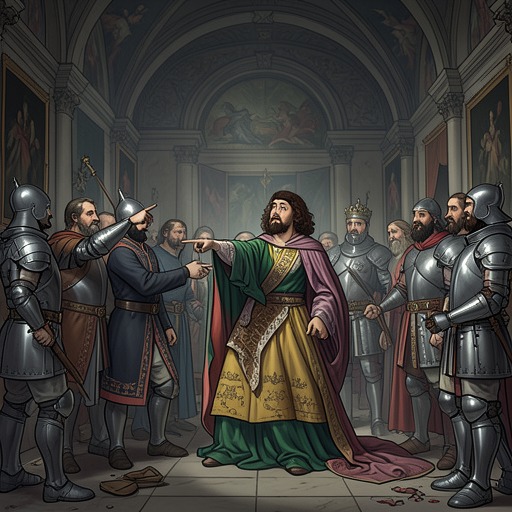
The conflict begins when twelve elderly ambassadors from Emperor Lucius arrive at Arthur’s court bearing olive branches. They demand that Britain acknowledge Lucius as lord and pay the tribute that, they claim, Julius Caesar and earlier Roman rulers had established. The message presents Rome’s authority as inherited and universal, warning that refusal will bring war and punishment. Arthur does not immediately answer: he first tells the ambassadors he will take counsel, and forbids his knights, on pain of death, from insulting or harming them. He has them escorted to lodgings and provided with what they need, keeping diplomatic protection in force even as the demand provokes his court.
Arthur’s reply rejects the premise that Rome has a rightful claim over Britain. After his allied rulers and knights promise military support, he tells the ambassadors that he owes no tribute to Lucius or to any earthly prince, Christian or heathen. He goes further than defending Britain’s independence: he claims a right to the empire through the title of his predecessors, the former kings of Britain, and announces his intention to march on Rome and take possession. He orders the Roman authorities to render homage to him as emperor and governor. His treasurer gives the ambassadors generous gifts and pays their expenses, and Sir Cador escorts them from the land. Courtesy and defiance therefore coexist in the embassy’s conclusion: the messengers are treated honorably, while the authority they represent is openly challenged.
The Campaign Turns Toward Rome
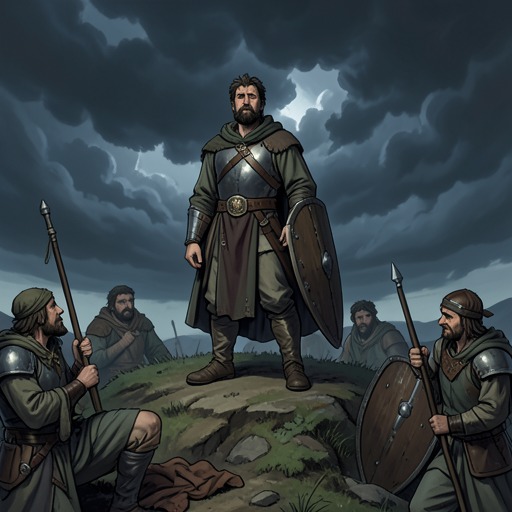
Arthur’s claim is backed by an alliance assembled at court. King Anguish promises twenty thousand fighting men, the king of Little Britain thirty thousand, and other rulers and leaders pledge forces of their own. Sir Launcelot and the remaining knights also promise support. The campaign is thus framed not simply as an isolated raid, but as a collective undertaking in which Arthur’s allies commit their strength to his dispute with Rome.
The decisive battle against Lucius takes place in the vale of Sessoyne, not in Rome. Lucius’s forces include Saracens, and the battle swings between advantage and disadvantage before Arthur sees the emperor fighting. The two rulers meet directly; when Lucius wounds Arthur, Arthur answers with Excalibur and kills him. The Roman army then flees, and Arthur’s forces pursue it. The account reports more than a hundred thousand dead on Lucius’s side. Arthur orders care for the wounded among his own followers and has the dead buried according to their rank, making the battle’s outcome both a military victory and an occasion for the ordered treatment of the campaign’s casualties.
The aftermath translates the defeat of Lucius into a message meant for Rome. Arthur finds among the dead the emperor, the Sultan of Surrey, the kings of Egypt and Ethiopia, seventeen other kings, and sixty Roman senators. He orders their bodies prepared and placed in lead chests, with shields, arms, and banners set upon them so their origins can be identified. Three surviving senators are sent to Rome with the bodies and with Arthur’s letters. They are to tell the Roman authorities that these dead are being sent as the tribute Rome demanded, and that Arthur will pay more upon his arrival if necessary, though he owes no other tribute. The stark reversal makes the campaign’s argument material: Rome’s demand for submission is answered by the defeated empire’s dead returning under Arthur’s terms.
Conquest, Coronation, and Rule
Arthur’s advance continues through Italy. At Urbine his forces take the city and raise the king’s banner on its walls. On entering, Arthur orders that his men not mistreat any lady, wife, or maid, and appoints a captain from his own country to govern the place. Milan, hearing that Urbine has fallen, offers money and submission, promising homage and an annual payment in return for Arthur’s protection. Arthur then proceeds through Tuscany and takes towns and castles, laying waste to places that refuse him obedience. The route to Rome therefore includes both armed conquest and negotiated submission.
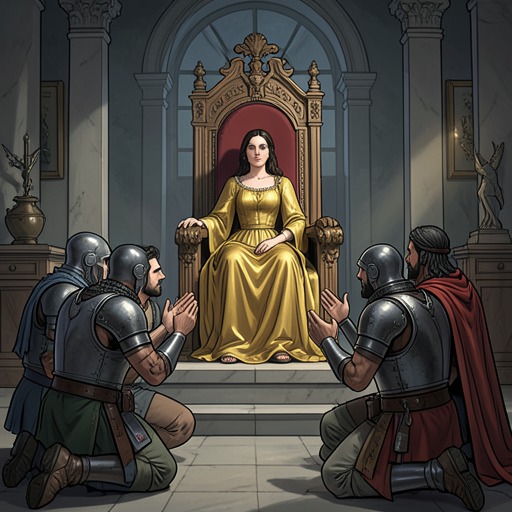
When the surviving senators and leading cardinals come to Arthur, they ask for peace and request six weeks to assemble the Romans and prepare to crown him emperor with the appropriate rites. Arthur consents, setting the coronation for Christmas and reserving the right to hold his Round Table with his knights as he wishes. At the appointed time he enters Rome and is crowned by the Pope with the full ceremonial dignity the account describes. The city’s role changes at this moment: it is no longer only the source of the tribute demand, but the setting in which Roman religious and civic authorities formally enact Arthur’s new imperial status.
After the coronation, Arthur stays in Rome for a time and establishes his lands from Rome to France. He distributes territories and realms among his servants and knights according to their deserts, with the account emphasizing that no one, rich or poor, complains. Sir Priamus receives the duchy of Lorraine and pledges lifelong service; Arthur also makes dukes and earls and enriches his followers. The imperial settlement thus extends beyond the ceremony itself, linking conquest to a new distribution of land, rank, and obligation.
Return and Significance
Arthur’s lords and knights eventually tell him that the war and conquest are complete, and ask leave to return to their wives after their long absence. Arthur agrees, observing that it is not wise to tempt God. Before the army departs, he forbids robbery and the taking of provisions without payment, under pain of death. Having established his rule and regulated the return journey, he crosses back over the sea and lands at Sandwich, where Queen Guenever meets him.
Rome’s significance in the episode rests on the difference between inherited authority claimed by Rome and sovereignty asserted by Arthur. The ambassadors invoke Rome’s prior rule and its demand for tribute; Arthur answers through his British predecessors, allied support, victory over Lucius, and finally coronation by the Pope. Yet the romance does not make the city the site of the decisive battlefield: the emperor falls at Sessoyne, and Rome becomes the place where the consequences of that victory are formalized. The sequence makes imperial power appear both martial and ceremonial, established through force but completed by recognition, governance, and the allocation of land.